Tag: education

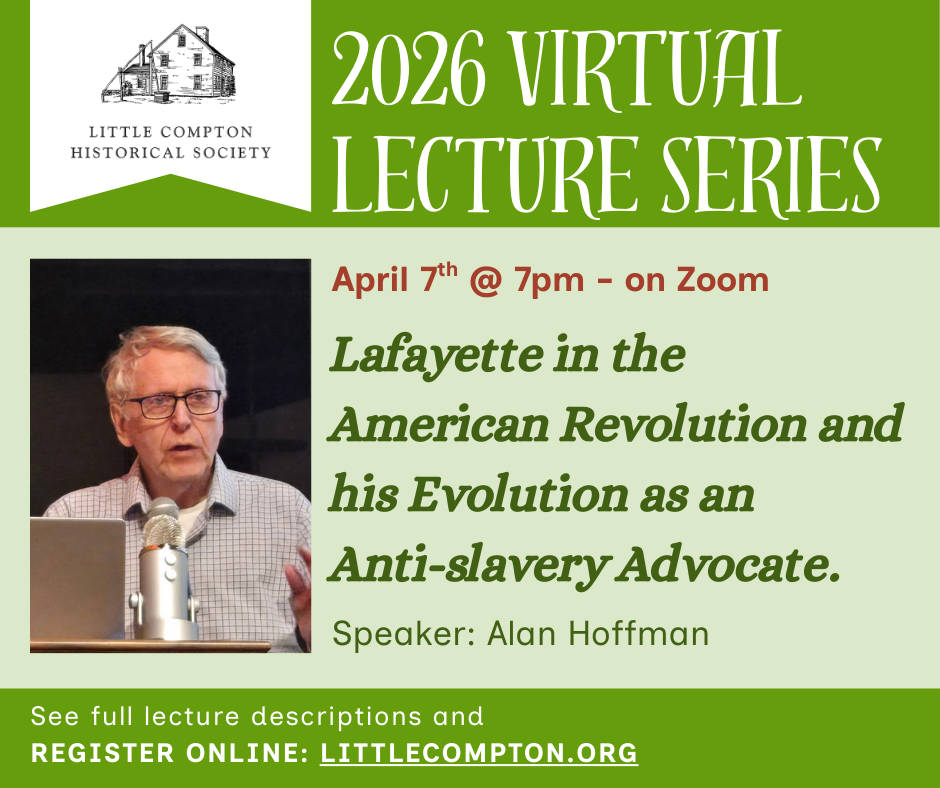
Spring Virtual Lecture Series: “Lafayette in the American Revolution and his Evolution as an Anti-slavery Advocate”

April 7 @ 7:00 pm – 8:00 pm EDT

Free Please register for the zoom. This event is free and open to the public.

Lafayette played a critically important role in the American Revolution, both as a general and as an intermediary between the United States and France. Moreover, experiences with African Americans during the war transformed him into a leading anti-slavery advocate. Lafayette’s most significant military achievement was the Virginia Campaign of 1781 which led to the siege of Yorktown and victory in the last major battle of the War. His signal diplomatic achievement was the dispatch of General Rochambeau’s army to America in 1780. Lafayette’s relationship with African Americans in the War, especially with the First Rhode Island Regiment and an enslaved double agent in Lord Cornwallis’s camp was the genesis of a 50-year commitment to the anti-slavery cause.

Speaker: Alan Hoffman

ALAN R. HOFFMAN obtained a BA in history from Yale before earning a JD at Harvard Law School. An avid reader of early American history, he “discovered” Lafayette in 2002 and spent two years—2003 to 2005—translating Auguste Levasseur’s Lafayette in America in 1824 and 1825, the first-hand account of Lafayette’s Farewell Tour of America written by his secretary. Mr. Hoffman has lectured widely on Lafayette—over 260 talks—and has spoken in each of the 24 states (and Washington, D.C.) which Lafayette visited during the Farewell Tour. Mr. Hoffman co-produced and was the principal author of virtual travelogues covering Lafayette’s Farewell Tour visits to four states: New York, Virginia, North Carolina, and New Hampshire (with TravelStorysGPS). Most recently, he edited and contributed to Lafayette and the Enduring Struggle for Human Rights and Democratic Governments (American Friends of Lafayette, Gaithersburg, Maryland: 2025). Mr. Hoffman currently serves as President of the American Friends of Lafayette and President of the Massachusetts Lafayette Society. He is also the editor of The Gazette of The American Friends of Lafayette. During the AFL’s Farewell Tour Bicentennial, he served on the Steering Committee that organized commemorative events in 24 states.

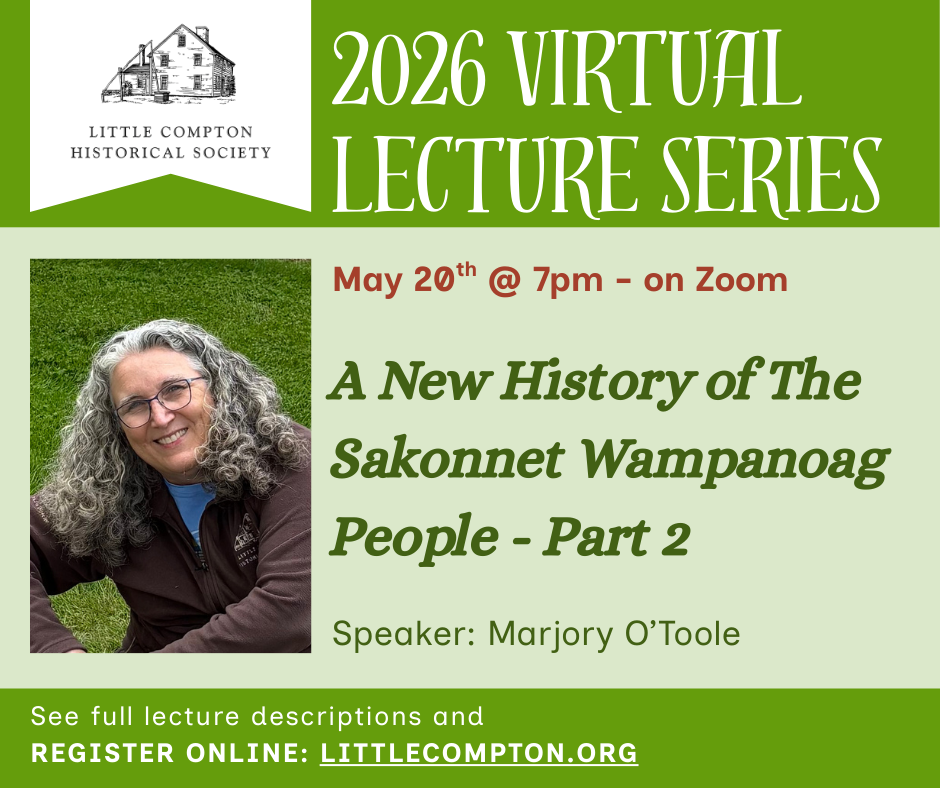
Spring Virtual Lecture Series: “A NEW HISTORY OF THE SAKONNET WAMPANOAG PEOPLE – Part 2: Life after King Philip’s War”

Speaker: Marjory O’Toole

May 20 @ 7:00 pm – 8:00 pm EDT

Free Please register for the zoom. This event is free and open to the public.

New research conducted over the last fifteen years has dramatically changed and broadened our understanding of the history of the Sakonnet Wampanoag people. We’ve been learning from Wampanoag advisors and studying historic documents, the archaeological record, and the Sakonnet landscape. LCHS Executive Director Marjory O’Toole will share some of what we have learned about seventeenth-century Sakonnet sachems like Awashonks, Takamona, and Mamanuah along with lesser-known individuals from more recent times including Sue Codimonk, Moses Suckanush, and Thomas Cooper. This second half of the history will explore the how the Sakonnets and their Acoaxet neighbors responded to the arrival of English newcomers, established a thriving Indian Meeting House on John Dyer Road, and continued to live on their homelands, slowing moving to neighboring Native communities. 

To view the first half of the talk presented at the 2025 LCHS Annual Meeting click here: https://www.youtube.com/watch?v=8TgkErwEie0&t=73s

The talk begins at 11 minutes and 45 seconds.

Speaker: Marjory O’Toole

Marjory is the Executive Director of the Little Compton Historical Society. She holds an MA in Public Humanities from Brown University and is the author or editor of ten local history books. 

Weaving for Kids

Weaving for Kids

Before we could buy back-to-school clothes in a store, kids had to help their parents make the fabric that made their clothes! Learn about how weaving worked by watching this video.

Then you can try out some weaving for yourselves, using paper.

Grown-ups, you can print the files for the warp (below), then cut construction paper strips that are the same width for the weft. Contrasting colors makes it easier for kids to see what they’re doing. The smaller width is more challenging for elementary-aged kids, and larger width is just right for preschoolers and kindergarteners.

This activity promotes fine motor skills, both with scissor skills and manipulating the paper. It also reinforces the math and critical thinking concept of patterns.

Theme: Overlay by Kaira.  © Little Compton Historical Society
548 West Main Road, Little Compton, Rhode Island
$0.00 (0 items)
0

No products in the cart.